
The Staffordshire History Network brings together museums, historical groups and societies, civic societies, research groups and heritage sites from across the county to share ideas, best practice, news, and training.
The SHN supports and work with sites and groups which are the custodians of collections, heritage sites or archives, or who carry out research and family history and who wish to engage and promote these activities to the wider public.
The Network aims to meet quarterly at venues across Staffordshire. A weekly e-newsletter is also available. For more information about the Staffordshire History Network email helen.johnson@staffordshire.gov.uk

Our next meeting
Our next meeting will take place in April. Sign up to the SHN newsletter to receive further information – register your details
Our recent meetings
The SHN’s quarterly meetings explore different themes, supporting members to look after their collections and archives and to make them accessible to visitors, researchers and the wider public.
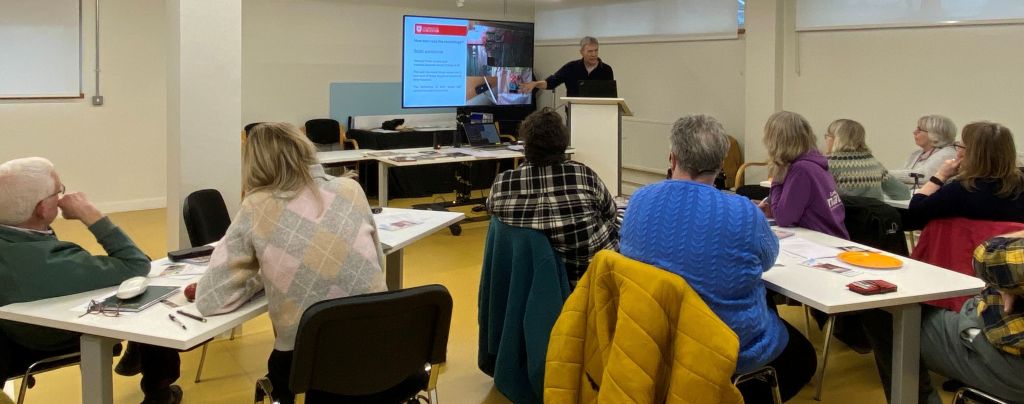
SHN Meeting – January 2025
Oral History Workshop
In January the SHN was hosted at the Staffordshire History Centre. The SHN welcomed Colin Hyde from the East Midlands Oral History Archive (University of Leicester) to the Staffordshire History Centre. Colin led an amazing workshop exploring the practicalities, pitfalls and experience of recording oral history testimony.
Colin covered ways to contact participants, planning an interview, asking questions, listening skills and keeping the interview moving forward. The group looked at consent forms, agreements, GDPR and talked through top interview tips. We also explored how to manage the interview data, storage, cataloguing and access.
The day included case studies and time to network and chat over lunch.
For more information on developing and running an oral history project visit the Oral History Society website.
“It covered everything I hoped for and much more and my expectations were high! I’m working on a 2 year NLHF Project which involves recording oral histories and sharing oral histories recorded from the 1950s to the end of the 20th century.” SHN participant
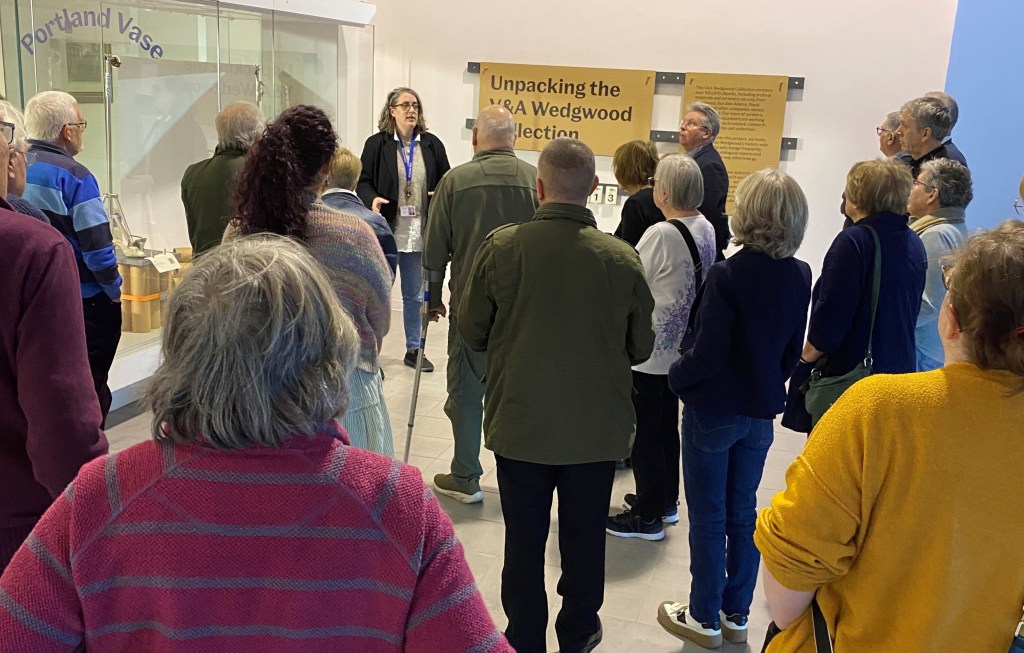
SHN Meeting – November 2025
Collections Project at V&A Wedgwood Collection
In November the SHN was hosted by the V&A Wedgwood Collection team. We were given an update on the cataloguing project being undertaken at the museum and the work of the volunteers who are supporting the unpacking, documenting and storage of this enormous collection over the next 5 years. The group was invited behind the scenes to view the work in progress and to look at the collection stores. The SHN would like to pass on it’s thanks to the team for giving up their time to give us the opportunity to find out more about this incredible project.
Colleagues from C’Art Art Transport Ltd joined the meeting to talk about how they can support organisations with safely moving and securely storing collections following an on-site emergency. If you are interested in finding out more about this email helen.johnson@staffordshire.gov.uk.
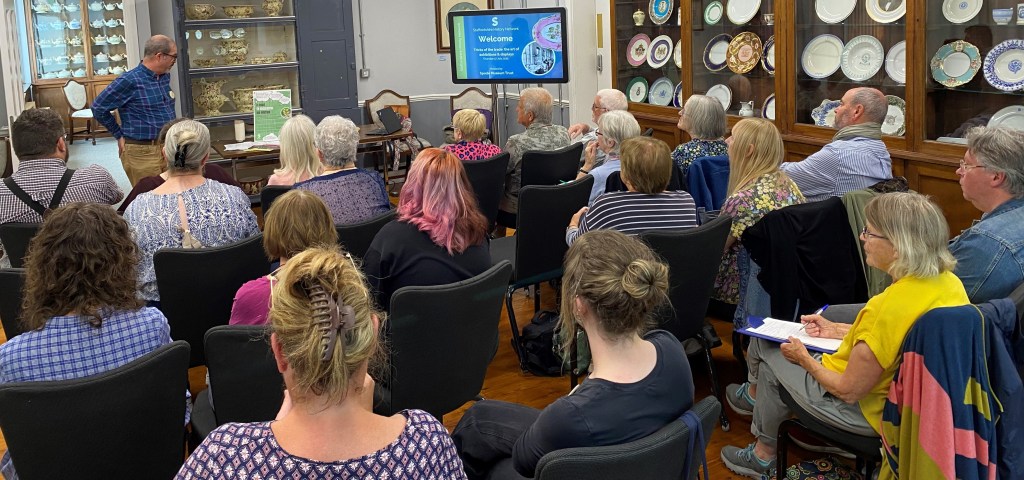
SHN Meeting – July 2025
Tricks of the trade: the art of exhibitions and displays
Our July Network meeting was hosted by the Spode Museum Trust. Sophie Harris, Collections Interpretation Officer at the Staffordshire History Centre explored the theme of creating accessible and engaging exhibitions on a smaller budget. Michael Escolme, Spode Museum Manager talked through the experiences and challenges faced by the team and how they have worked to develop an engaging, changing and accessible visit.
Top tips for developing an exhibition
Have a plan – there will always be something that comes along that isn’t in the plan, but it helps to have one!
Work with a team if you can – share ideas, develop themes and work together to develop a brief for the exhibition. This can be used for external designers if you are using them or as a more informal document for use by the team.
Decide on your outcomes – outcomes help with decision making. For example, ask yourself what you want your visitors to take away from the exhibition.
Develop an interpretation plan – once you have your broader themes this helps to refine them and to identify the areas you want to cover. Be aware of having too many! This plan will help with identifying the objects and documents that will be linked to each section.
Lead in time – this will depend on the scale of the exhibition. 12 months is a good lead in time if you are working with external designers.
Mood boarding – these can give you a good visual impression for each theme and helps your team/designers to visualise ideas and create content.
Mapping the exhibition space – this makes the whole process simpler and enables other team members to visualise how the exhibition will work in a particular space.
Don’t worry about the tech! – visuals and plans can be handwritten on a piece of paper.
Use online tools – there are some great online tools that can help you with creating interpretation panels, posters etc. One of these is CANVA. This is great for lower budget, in-house exhibitions. A free version is available online, and the higher spec. version costs around £100 annually. It can be set up for professional printing.
Audiences – know who the exhibition is for. Are you targeting particular groups? Use professional organisations such as the Audience Agency to help you identify your audiences. There are free resources available on their website.
Gathering feedback – make it exciting and interactive and you will get more responses.
Community engagement – offer a free session at the venue used by the group you are speaking to. Ask questions and get feedback – this can be used to support the exhibition development.
Using external designers? – remember that you are the client. Ask them questions, make use of their expertise, write into the brief that you want to be able to reuse and repurpose exhibition elements in the future (value for money and future proofing), be inspired by their design concepts – take on and reuse their ideas!
Or doing it yourself? – use the online tools available. Find a ‘creative’ in your team and utilise their skills, engage a graphic designer, look out for training and online courses.
A book on the wall? – think about reading ages (the national age is 12), try not to have too much text and don’t make it complicated. Always get someone to proofread it – before it goes to print!
Accessibility – keep font sizes to a minimum of 16pt and use a sans-serif font which is clearer and easier to read. Text in CAPITALS can be tricky to read and think about colour contrasts between the text and background. For the wider exhibition spaces consider how you use the space and have clear delineation between different areas, use audio and sensory elements where you can and think about access for wheelchairs – this will improve access for families with pushchairs too!
Objects – do you have what you need to tell the story? Can you borrow items from another museum or organisation? Can you use images, photographs or documents? These can be scanned or photographed if you have limited display space – use them in interpretation panels.
Interactives – these can be complex and expensive if you have the budget available – or you can keep it simple by using handling items purchased from a charity shop. Keep it considered and neat and it will engage your audience.
Have a decent toolbox – good quality tools are essential. A good drill, screwdrivers etc are useful items and it is worth paying a little bit more for good quality which will last. Velcro and other light weight fixers are good for attaching and displaying non-collection items. Companies such as 3D Displays Ltd sell acrylic stands that can be used in cases – https://www.3ddisplays.co.uk/
Take aways – visitors won’t miss what they don’t know, so don’t panic! The process is trial and error and there will always be something … learn from it and have fun!

SHN Meeting – April 2025
With a little help from our friends …
The SHN met at Ingestre Orangery in April to explore how we can work in partnership to become more sustainable organisations. We were joined by Richard Totty, Chair of the Friends of Staffordshire and Stoke-on-Trent Archives Service who spoke about how FoSSA work to support the Service through fundraising activities and advocacy.
Sharon Forman, Archivist with Heritage and Culture Warwickshire, looked at how they are working to support groups and communities to develop, share and care for archive collections in the County.
Sarah English concluded the meeting with an overview of the how the Staffordshire History Centre project has developed, and continues to work in partnership with the William Salt Library Trust and the new Staffordshire History Development Trust which has been created as a charitable fundraising arm for the Service.
SHN Annual Review 2024-2025
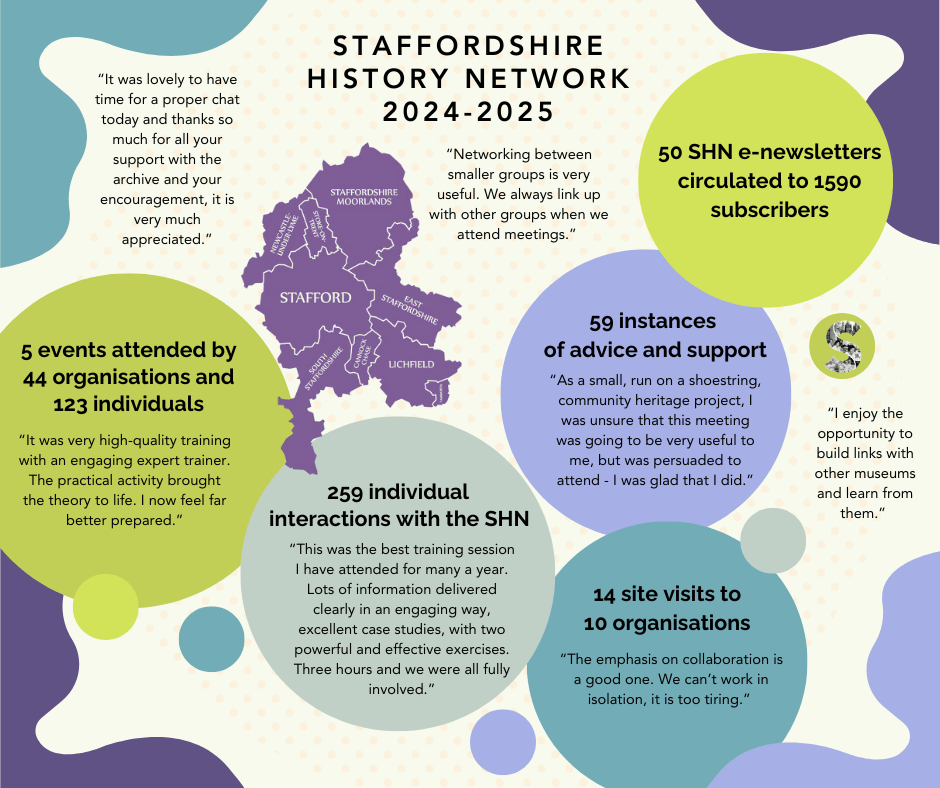
SHN Meeting – February 2025
Down to business: Taking a more entrepreneurial approach to your heritage offer
Our February Network meeting was hosted at the Staffordshire History Centre where we welcomed Alex Nicolson-Evans, founder and Director of Living for the Weekend. Alex is an experienced commercial director and managing director with a track record in leading and developing cultural businesses, project management, sales and major events.
The session focused on ways that heritage organisations can unlock their potential for growth through the use of data and technology. Knowing who visits and uses your sites, why they do and what they enjoy or don’t enjoy allows us to:
Create better programming tailored to audience needs
Design more engaging marketing campaigns to grow audiences
Improve the visitor experience
Alex explored the ways we can use data to support us. She looked at the different data we collect, including numerical and social analytical tools, and outlined ways to interpret and use this. She also gave an overview of free online tools that can help to ensure we are optimising the use of our websites and surveying our visitors.
After the break the Alex presented case studies on developing audience offers at Sarehole Mill and bite sized insights from Birmingham Museum Trust, showing how small changes can make a big difference.
“Another very useful and informative session. Lots of interesting information and a useful look at how to use data with marketing. Loved the examples and also the opportunity to interact with people from other organisations.” SHN participant
“Alex’s emphasis on collaboration is a good one – we’ve all realised we can’t work in isolation – it is too tiring.” SHN participant
“The key point I have taken away is we need to have as much data as possible from every source. It needs to be all viewed together to give us a stronger picture of our audience, their wants and needs. It became clear that it helps us to see not only what is working but to identify why something isn’t to drive our decision making.” SHN participant
SHN Meeting – November 2024
Let’s get digital: Exploring best practice in digitising collections
The November (2024) SHN meeting was hosted by the Brewhouse Arts Centre in Burton. Staffordshire Archives and Heritage Service Collections Manager, Chris Copp, and Digital Officer Ben Cunliffe talked through the practicalities and considerations around digitising and making collections accessible. The use of meta data, file formats, equipment, copyright and online platforms were all covered.
‘Digitising museum objects [etc] means making copies of physical originals in digital form – for example, by scanning or photographing 2D items or transferring the contents of reels of film or audio tape into digital formats. It can also refer to 3D scanning of objects or, more loosely, any digital photography of collections.’ Collections Trust
Full session notes are available on request by emailing helen.johnson@staffordshire.gov.uk
The second half of the meeting was led by the team from the London and Northwestern Railway Society – https://lnwrs.org.uk/. The team have benefited from funding, allowing them to invest in some great digitisation equipment. This has directly supported the society in scanning and making their own collections accessible, but the team are also using the scanners to support other local groups and individuals. They brought a light weight scanner to demonstrate what they can do.
Participants also brought items from their own collections to discuss the best approach to how these might be digitised.
If you have a question or would like support around digitising items from your collections please email helen.johnson@staffordshire.gov.uk

SHN Training Event – September 2024
Emergency Salvage Training
In September Historic Stafford and the Staffordshire History Network joined forces to run a practical emergency response training session. Historic Stafford kindly hosted the group of staff and volunteers from museums across the county at Stafford Castle. The training was given by Emma Dadson of Harwell Restoration Ltd. Emma gave an overview of disaster response and case studies before the group moved on to a practical exercise which explored how to deal with a range of wet materials.
One participant commented, “This was the best training session I have attended for many a year. Lots of information delivered clearly in an engaging way, excellent case studies, with two powerful and effective exercises. Three hours and we were all fully involved.“
SHN Annual Review 2023-2024

 Staffordshire History Centre