In March we welcomed Martha from The Hart School, Rugeley for a week of work experience with the team at the Staffordshire History Centre. Read more about Martha’s experience below.
“Hi, my name is Martha and I am in year 10. I am quite interested in history, and it is my favourite subject. I decided to come to the Staffordshire History Centre for my work experience so that I could learn more about the subject and have a taste of what life when I finish school will be like.
I was working with different people each day and they showed me what their job entails. It made me realise that there are many different jobs surrounding the subject of history and you can bring a range of skills to it.
Now I will breakdown what I did on each day of the week at my placement. On Monday, when I first arrived, I was given an induction; this told me where all the fire exits were and the health and safety guidelines I needed to follow. I was also given a tour of the William Salt library, the record office and the museum itself, it was very interesting. After this, the plan for the morning was to be with Lisa, the conservator. She specialises in preserving old documents and artefacts by keeping them in the best conditions possible.
One of the ways Lisa does this is by making boxes and envelopes out of card to ensure documents are packaged safely when taken out of the strongrooms, if they have needed to be taken out. I helped Lisa make these boxes and she taught me how to use tools such as a Stanley knife and a bone folder. In the afternoon, I did a research task on the origin of tea and tea figures. Tea figures were on display at the History Centre during the time I was there, but the exhibitions change often and vary. I enjoyed this task as I like learning about new aspects of history and the tea figures on display were actually from Stafford.
Tuesday was a bit different to the other days as I wasn’t at the History Centre but the Museum Collection Stores instead. Here, I spent half of my day in the warehouse where all of the museum’s collection stays when not on display at the History Centre. I went into the art store, and I saw all of the amazing artwork that has been preserved from many different periods of time, it was very impressive. As well as this, I went into the costume stores. In there were several uniforms of for example, the police; these came from the 19th and 20th century. I learned about the location system of how things are stored in the unit and how items have to be numbered in a certain way, this is with shelf, bay and storeroom, it must be very exact. I categorised some items and labelled where they needed to be located.
After my lunchbreak, I unwrapped various artefacts and random items such as a yogurt pot from the 1980s and ultimately did a stocktake of all the things that were meant to be in the box. This was very important as it makes sure that all items have been put back and accounted for after potentially being on display at the History Centre or being requested by the public to see. It has to be done every few years and it took the remainder of the afternoon for me to complete 2 of these boxes.
When I came on Wednesday, I spent my morning with the public service team. They explained what legal forms need to be filled out when members of the public request access to certain documents or want to read books from the William Salt Library. These forms determine who has access to what files and what legal guidelines have to be followed. I also went upstairs to one of the very large storerooms, it was one of six I believe and it had thousands of records. I was amazed by how many there were and couldn’t imagine the stress of having to stay on top of the numbering system. We talked about the different types of documents that were stored at the History Centre, and I found it incredibly fascinating.
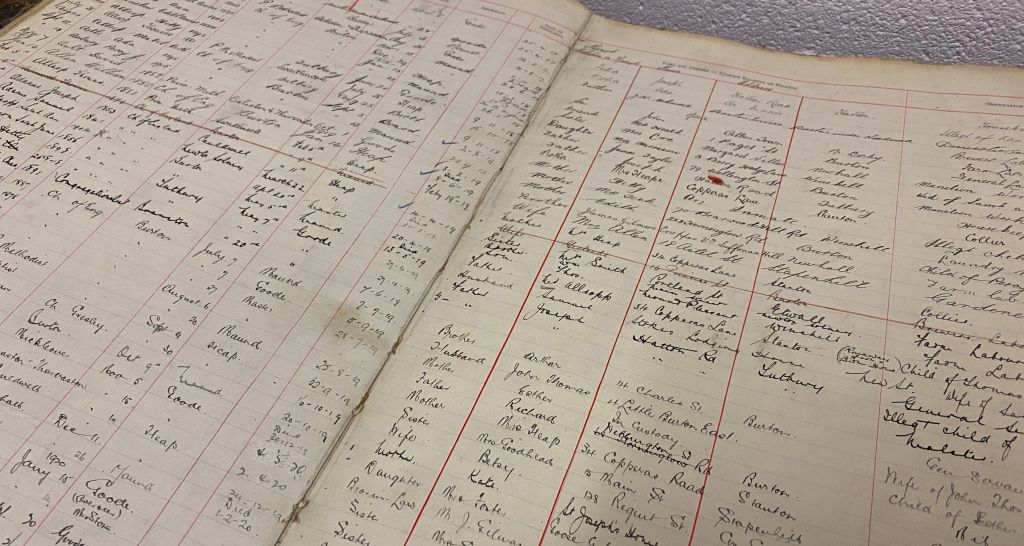
During the afternoon, I was given a workhouse record book of people who had stayed at the specific workhouse during the 1800s and 1900s. It gave information on the person’s religion, date of birth and date of discharge from the workhouse. I had to transfer these details onto an Excel spreadsheet. It was slightly tricky at first as the handwriting looked completely different but as I kept doing it, it became much easier. I really enjoyed doing this, so I was happy when I got to do more of this the following afternoon. As for Thursday morning, I did prep for the Easter activities that the History Centre was going to be doing. This ranged from me using watercolour paint to researching about items from the First and Second World War. I did this on a laptop in the research room, it was amazing to see how things were specially adapted when at the time, there was so little technology.
On my last day, I spent my morning doing junk modelling and built a small replica of a Tudor house. This was going to be used for the Easter activities, and I loved getting to be creative with cardboard and different materials. In the afternoon, I did more prep and wrote this blog.
In conclusion, I really enjoyed my week at the History Centre as I got to experience somewhat of how going to work feels like, learnt more about my favourite subject and was able to understand a few of the many things that take place behind the scenes at a museum and the importance of this.
My favourite part was probably looking through the workhouse record book as I could develop skills on palaeography and learnt how tough times were for many people in the past. If you are interested in learning more about history and developing different skills in this area, then I would definitely recommend picking the History Centre as your work placement.
 Staffordshire History Centre
Leave a comment