Researching the political correspondence of Edward Littleton, later Lord Hatherton of Teddesley Hall.
The Hatherton Volunteer Group are researching and cataloguing the political correspondence of Edward Littleton, later Lord Hatherton of Teddesley Hall. The group meets monthly online to share information and work through tricky documents together. In this article the group shares some of the findings made in correspondence with a Mrs Slade.
Lord Hatherton had a very wide circle of friends and political allies. While some of the correspondence is dry, the letters can be witty, some downright scurrilous and others provide Lord Hatherton with detailed political comment. One such writer is Mrs Slade.
Mrs Slade’s identity was initially a mystery to us. She writes very long, detailed letters to Lord Hatherton from revolution-torn Vienna in 1848. But who was she? The volunteers’ research revealed a fascinating but long-forgotten Staffordshire character.
We first found a reference to Mrs Slade in a booklet ‘Senora Small Fry: Mary Barker and the Lake Poets’ by David Bradbury. From this we discovered that in 1830 a Miss Mary Barker, at the age of 53, married Mr Slade Smith, a businessman 20 years her junior.
Mary Barker/Slade moved widely in the higher echelons of society and was well connected in intellectual and creative circles. She was close to Charlotte Smith, a famous novelist of the day, and she was a much-valued friend of the poet, Southey. She wrote a novel, composed poems with Wordsworth and she was an artist. Whilst living in Schloss Eggenberg in Austria in 1843 she tells Lord Hatherton that four of her works were exhibited in Vienna – one she calls, ‘a mere study from Nature begun and finished on the spot’. In the same year the Danish artist Ditlev Blunck stayed with her and later she produced a treatise on paints and varnishes. This work, now in the Wellcome Collection in London, had belonged to another of Mrs Slade’s friends, Peter Hubert Desvignes, the architect who renovated the Palais Liechtenstein in Vienna. None of her paintings seem to have survived; at least we have not been able to trace any.
But why was Mrs Slade writing to Lord Hatherton, a Staffordshire politician and nobleman, rather than to her usual literary and artistic set? Further research reveals Mary’s Staffordshire roots.
Mary Barker was baptised in Penkridge in 1774 and in her youth she was a companion to Sir Edward Littleton of Teddesley Hall, a widower over 45 years her senior. Mary’s letters show she had a lively wit and she must have been stimulating company: she was a competent linguist, well taught in art and music, and played the harp. Mary may well have been Sir Edward’s protegee or the daughter he never had. They clearly had a close friendship, which continued to be valued by Sir Edward’s great-nephew, Lord Hatherton, to whom she wrote until the end of her life.
What she was doing in Vienna in 1848? Reading between the lines, it would appear that Mr and Mrs Slade had run up debts and, like so many others before and after them, moved to the continent to live more cheaply. They lived in France from 1830 and by the 1840s they were in Vienna. Despite their ‘poverty’, they owned a small chateau near Boulogne which they leased out to provide an income. The pull of Vienna, must have been the cultural attractions.
Why are her reports are so interesting? Mrs Slade’s first letters from Vienna are dated 1847. This was already a year of riots and then 1848, especially the month of October, saw full blown revolution. Astonishingly the Slades remained as long as they could only fleeing in late October, to be back again by 10 November 1848.
Her letters reveal a sense of humour even in the appalling situations in which she finds herself during the revolution. She gives an amusing account of her husband and his Slovak friend being held at gun-point by trigger happy rebels but it must have been terrifying. Her sources of information are wide and include her husband’s hairdresser, a blacksmith’s rebel brother and a young lady who had two lovers among the rebel students. They add colour and dimension to her descriptions of the dramatic and deadly events unfolding before her observant eyes. Her letter of 10 November 1848 shows her fondness for Sir Edward, and there is a passing reference to his formerly-enslaved Butler, Cyrus Hamilton, who featured in our recent Staffordshire and slavery exhibition.
As well as the valuable work, we have great fun in the monthly meetings!

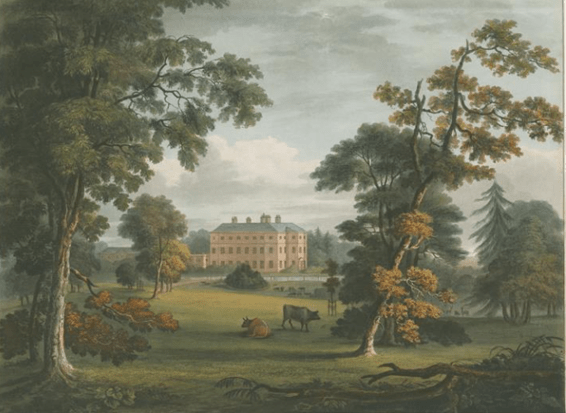
(Image courtesy of Staffordshire County Buildings Picture Collection)
Mrs Slade letter 10 November 1848 D260/M/F/5/27/18/64
Vienna Novr 10th 1848
My dear Lord
On Monday last we quitted Mőlk [Melk], tempted by a loncochere [presumably carriage driver] returning from Linz where he had conveyed part of the family of our friends the Duvignes. This better than encountering the severe cold wind on the Danube. The coachman insisted in cramming a lady into our coach, already crammed full and engaged for ourselves only. But as our Sclavenian had discovered that the fellow was a furious Republican who talked of shooting Windish grats [Windish-Grätz] and the Kaiser as coolly as possible we thought it best to submit – and had some reward in learning a great deal from the lady concerning the late events here and of the wars in Hungary, where she had been all last summer with her husband, who is a physician in the Austrian Army.
We entered by the Mariahilf Barriers, consequently saw the houses there destroyed, pavements torn up on both sides of the street, and at the entrance of nearly every one joining the High Street and where barricades had been erected. The Stadt looked dreadful, with the Bourg Thor [Burgtor] a ruin in the middle part. The top of the Church of St Augustine is fallen, & the top of the Imperial Library a black, shatterd ruin. Nearly every window in the grand new Caserne [Kaserne] near us broke, &c, &c. On arriving at our ancient lodging we found that not a single ball had struck this house – only one had passed between the legs of the Housmeistor without wounding him, as he stood at the great open door of the entrance. The Croats, we were assured, had entered houses innumerable, killed, destroyed and stolen without mercy – particularly in the Leopold, and very much in the Landstrasse, but, excepting meeting many of them on our staircase – Thank God! – we found [it] as we left it.
Ten minutes after, I had the delight of receiving your delightful letter of the 15 of last month. Oh my dear Lord! Speak not of wishing to write more interesting matter! Ten lines from a friend to a person in exile is of far more worth that an exile can return – and such a one am I, removed from all national ties, all old friends and association, &c. Your letters are ten thousand times of more value to me than anything which I can possibly write.
You cannot imagine with how much pleasure I have lingered on its contents, during the last few days, and how long they will afford me pleasant thoughts. What solace for my heart and my imagination, amidst the horrors which surround me, to convey my mind in my sleepless nights to dear Teddesley and its vicinity!
What pleasure to read in the newspaper which you kindly sent me (and for which I thank you very much) of, in a house of yours at Penkridge, of a drawing room and china closet! Then – an artist there!! And a lady with a gallery of pictures – and a conservatory!!! Oh! it is delicious to think of!
The house at Congreve must always be odious, build what they will, after they have destroyed all the garden & shrubbery in front. Dear Sir Edwd Littleton hated farming, and did not find one decent house on the estate when he became in possession of it. He built for a class very much above what he found, but not equal to the present class of farmers. He thought principally to have the dairy to the north – and of beauty – nothing! But his sheds for cattle were excellent and his labourers’ houses, which I copied times innumerable for different noblemen who requested them from him and who invariably said they were excellent but too expensive. On which he replied to me “What is it to expend a hundred pounds to make a poor man comfortable for life?”
For tenants I will relate a little annecdote [sic] which cannot fail to amuse you much. Not more than two years before he died, I am sure, Cyrus came into the green parlour just as we had finished dinner, brought a letter from a lady which he said that the person who brought it was waiting in the pantry for an answer. After reading the letter Sir Edwd went there; and when he returned he exclaimed to me “That woman must be a D…d Fool!”. Why? said I. “Why? She has sent to recommend to me strongly as a tenant a fellow with a grey head!” On this I burst into an immediate fit of laughter. “What the D…l are you laughing at?” exclaimed he. “Laughing!” I replied “Well I may! For I dare say that this man is young enough to be your grandson”. “Oh!” he continued, without regarding my criticism – “Mary! Never while you live take an old tenant! Those old fellows are good for nothing! All full of prejudices and no spirit of improvement in them!” &c, &c
For drainage – it is wonderful to me that you do not know how much he did. I well remember going with him more than once, to see the drains making on the new principle of cutting springs at the tops of hills, after boring with a machine made to find them. And on the side of Preston Hill I saw an open drain, probably nearly twenty feet deep – partly laid with round, earthen pipes, if they can so be called, covered with heath &c. The tenants must have supposed these drains to be [?blocked / chocked?] at the bottoms, if you know nothing of them.
Mr Hall is one of the greatest scoundrels in existence. Sir Edwd lived long enough to know that, and Mr [?Brecout] most bitterly to lament that ever he had been taken in by him sufficiently to recommend him. I possess now two letters from Mr Moreton Walhouse to him, which he gave to Sir Edwd who gave them to me, which would prove to you that I speak of him with moderation. Perhaps it would be but that you should possess those letters. If you think so, I will send them to you.
How often, my dear Lord, do I wish that you had ever known your great-uncle. Very few people ever did so, in reality – and certainly no one in your family. Little did any of them suspect that he hated your grandfather more than he hated any man on earth – and had great and good reasons (as I could prove to you) for disliking his sister. But I must quit all other subjects for our horrid scenes here. I have waited a few days to gather some intelligence which is not in the newspapers after reading a heap of Galignanis.
I give you great credit for discovering so soon from their beginnings in rebellions and attrotious actions, the extreme weakness of these people. All these horrors, for what? Because two regiment were being quietly moved from Vienna into Bohemia!!! As to their noble National Guard, they have suffered very little for they scarcely fought at all. The thousands who were killed were the Guard Mobile, the Proletaires and some hundreds from Moravia, with some students.
Saturday morning
I would not send this letter today because I wished to acquire certainty respecting the execution of Messenhauser, the last commandant of the National Guards in the Graben yesterday morning. We now believe that he was not shot, but a Frenchman certainly was, and two others, in the Graben.
Fifty nine soldiers were hung on Saty last, and many more on Monday. Executions have taken place every day since our return – and a great many, I fear, today, as firing was heard in the Alten Forstadt which continued for more than half an hour. Firing does not take place here now for anything but executions. Not only are the National Guard disarmed in Vienna and all the country round, but every individual now, of whatever country who did not deliver any kind of fire-arm or weapon in his possession would be shot. Unfortunately the persons in authority have not yet discovered the most guilty, who have caused all this Stupid Revolution and all its horrors.
Behn [? Jellačić, Ban of Croatia] is escaped into Hungary. Not one of the other demagogues have yet been taken. About a hundred students are made prisoners and confined near the headquarters of Windish gräts, where they are singing from morning till night. About eight hundred were in the University when it was taken by storm by the Croats. They saw the guns all pointed on the formidable barricades surrounding it but no one fired – & when they entered they found only a few hundred women and young girls! Not a single man was there! All had escaped by subterranean passages known only to themselves. This account you may rely upon as correct. We learnt it yesterday from our Sclavenian who learnt if from a pupil of his – a young lady who has two lovers amongst the students. She has told our friend, in confidence, that about eight hundred of them are now in Vienna. Doubtless, as soon as they knew that the Bourg Thor was entered, these heros [sic] began to shave themselves and put on the disguises long since prepared, in which doubtless they were assisted by the ladies found in the University. All the professors formerly there were Jesuites. The subteraneans were more probably enlarged and improved by them upon ancient works, when such were common in all fortified towns, and care was undoubtedly taken that such secret issues were kept a profound secret, in the breasts of some superiors. This makes the conduct of these demagogues and students a thousand times more wicked and despicable than one could suspect. They encouraged and provoked all the others to fight – to murder soldiers innumerable who had entered the town by a small door on the strength of their white flags – and after all the dreadful slaughter of a month’s continuance, knew that they themselves could always escape!!!
When the Imperial Library was perceived to be on fire Jellachic exclaimed ‘Now we must not wait another moment! We must storm the town!” After the Bourg Thor was entered, there was no defence made at any of the barriers, and no fighting excepting in the St Stephan’s Place for about a quarter of an hour, with the Guard Mobile. How the Guards National fought a companion of our Sclavenian in the company which he quitted some time since will inform you. The narrator was one of the actors. That company was ordered to do duty for the night at one of the outward Lines. After a merry dinner at which amidst their cups they boasted that they could, and would, fight and kill all the soldiers with wet rags (a German mode of expression) &c, &c, they proceeded to their station where the perceived a formidable row of cannons pointed against them. ‘Oh, we are all dead men!” they began exclaiming, with lamentations, &c, &c without ceasing. “Fall down on your faces! and ly [sic] flat to the earth!” This order was obeyed instantly. “Now do as I do!” was the second; which was to glide along in that flat position by the aid of their hands and feet to a quarry at some distance, from which clay had been dug to make bricks.
They succeeded in reaching, and sliding into it, and then fortified and covered themselves with clay as well as they were able – to shelter as much as possible from balls which might fall amongst them. They remained in that position many hours and when they thought all quiet, ventured out in order to reach a shed nearer home. But they were discovered in their flight whilst they were arming themselves, and uttering self reproaches for having quitted their strong-hold. Some few were killed, and the rest who ran away, I think, will never live to fight another day”
A little annecdote [sic] told us by our travelling companion who was in Hungary when the circumstances occurred would amuse the Duke of Wellington, by reminding him of what occurred at his own famous Battle of Assaye in India. At Essig there was a large camp of Serves [Serbs]. The cholera broke out in it and was said to be so violent that hundreds died daily, and all approach was strictly forbidden, but the Hungarians could see coffins innumerable hoisted into the ditch daily. The living intended to quit the camp and fly on the approach of the Hungarians, but in each of these coffins left in the ditch was enclosed a stout soldier, fully armed, & four days’ provisions enclosed with them. So when the Hungarians had part [?departed] they meant to start from their graves and pursue. This brilliant scheme was frustrated by a traitor.
I found a letter from my Pesth friend on my arrival here. She says she was present at the Conference when the President read the Proclamation which invested Jellachic with the supreme power in Hungary. It was received, she says, by the “rires aux éclats” of all the Assembly.
This says more than a thousand violent speeches. Jellachic was beaten there, be assured, and 2 of his Genls [Generals] with 62 officers taken prisoner after the great battle when he demanded a suspension of arms for 2 days. 7 thousand men laid down their arms after, she says, “l’honteuse faite de Jallachic”. These 7 thousand of his [?armie of] thousands have sworn never to take up arms again contre Hungary.
At present there is no post from [?Nonas] to Pesth and all is vague report. Yesterday it was said that Presbourg had surrendered.
There are about forty thousand troops in, and close to, Vienna. Jellachic himself is in the next house to us on our left hand – the palace of Prince Maximillian. Nine of his officers, and as many soldiers, are quartered in this house.
Sunday
It is said confidently this morning that the last commandant of the National Guard, Messenhauser, was shot yesterday, near the Carolia Thur, which is vis a vis to us.
I had the pleasure of receiving your letter addressed to Mőlk which I must merely thank you for at this moment.
The Hous meistor brought us up a paper on which must be written the name, profession, age and place of birth of every individual in every house in Vienna. This is a very good thing and I hope may lead to the discovery. I made my husband set down my real place of birth, Congreve. I should not wonder if some of the wise-acres should come to question me concerning Rockets! The House meister told us that the French, the Russians and the Turks are coming here immediately!!!
This morning it is said that Radetsky has been beaten in Italy and is now in the Tyrol and that the Turks have entered Croatia.
God forbid, my dear Lord, that you should have so much news as this to write! If half is true I will pack up to be prepared for flight – but write, I pray you – some consolation is greatly needed here.
Count Colleurat’s [Kolowrat’s] house on the Basty [Bastei] is completely destroyed by the bombardment from the Schwatzenburg Garden & Count Sandor’s injured, the Leopold-Stadt half a heap of ruins but [?no] Palace of Prince Litchtenstein injured.
Our friend’s house near the Odeon scribbled with balls but the family luckily escaped in time.
Every one must have a pass to enter the town. Gentlemen innumerable were shot or run thro’ with a bayonet here, of whatever country they might happen to be, if they refused to join and fight with the insurgents.
Ever, my dear Lord, yours most truly
Inserted longwise in margin of Page 8: All the Linies – everything was taken by storm. The bombardment was neare at Olmutz
NOTES
The Galignani brothers were bookshop owners and publishers in Paris
Caesar Wenzel Messenhauser, Commander of the Vienna National Guard, shot in the city moat, 16 November 1848
The Congreve rocket was a type of rocket artillery designed by British inventor Sir William Congreve in 1808.
Anton, graf von Kolowrat, former Minister-President of Austria
 Staffordshire History Centre
Leave a comment