Cara was our second work experience placement this summer. This is her reflection on the week she spent working with the team.
My name’s Cara and I’m a Year 12 History student from a local Hednesford high school. I’ve been interested in history for a long time, with it being something I want to pursue into university studies. When my school informed us of our needing to complete work experience, I was eager to find something that would match my interest in history and help expand my understanding of available careers in the sector. The Staffordshire Archives and Heritage Service transpired to be the answer to my search, and after getting in contact with Helen (the team’s Community Engagement and Partnerships Officer) and having an informal interview at the start of the year, I embarked on my week of work experience in early July.
My week with the team was a highly varied, interesting and engaging one. I spent the first day undergoing induction and touring the service’s central sites housing the various collections including the strongrooms and the William Salt Library collection. It was very impressive to realise the scale of what the service cares for, in both the antiquity of the collections and the variety of objects within them from back issues of newspapers from 1770s to local tithe maps. In the afternoon, I began to sort and alphabetise a box of micro-fiches containing some of the records from the town’s old mental health hospital St George’s – a deceptively simple but enjoyable and engaging task. I also helped Helen to develop a session for an upcoming outreach group by contributing to the creation of a game they could play that would be both enjoyable and feasible to complete given the parameters of the room and the size of the group. As well, I worked with Lizzie (the team’s Learning Officer) to develop some more resources around crests that can be used in sessions with young children, hopefully so that their experience’s in these sessions are improved. It was nice to feel that I have been able to make a somewhat meaningful contribution that may interest more young people to pursue history!
On Tuesday, I was up at ‘G’ – that is Unit G, the service’s museum collection store. Here I got to look round and see the incredible range of artefacts the team cares for – from old carriages to beautiful doll houses to the death mask of the infamous Rugeley poisoner! I was also able to see the extensive collection of clothes that are housed there (ranging from early 1800s up until the late 20th century) and of artwork which covered all manner of media and matter.
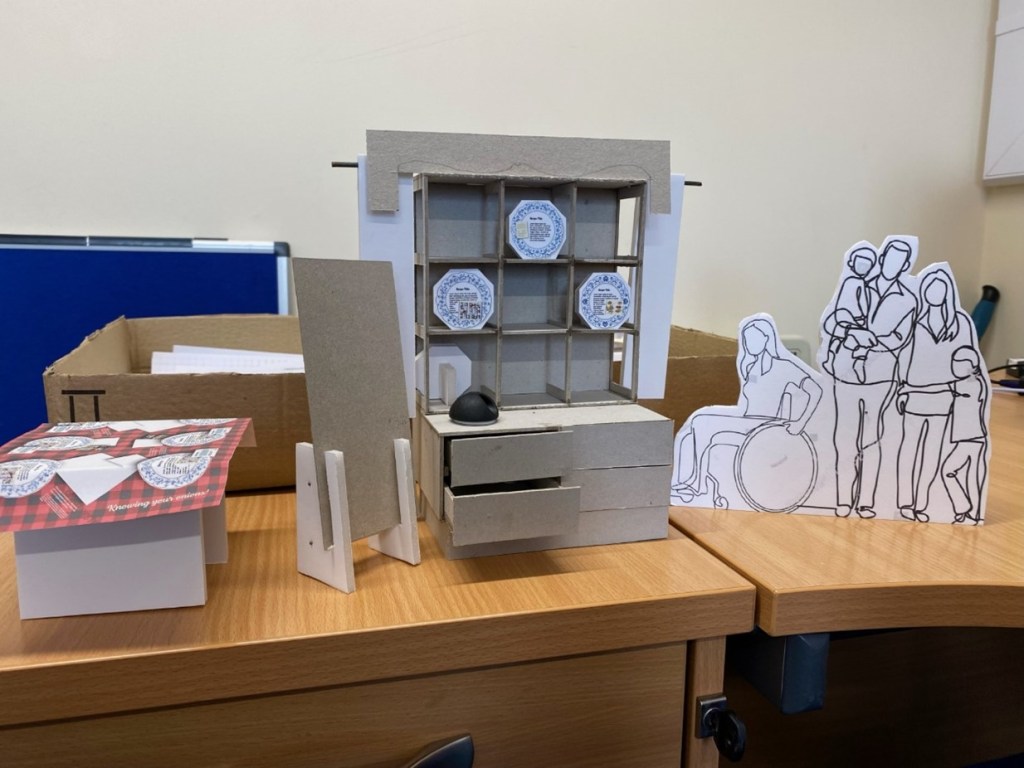
In the morning, I sat in on a meeting with some external designers to discuss the planned design of an upcoming exhibition the team have planned, and was fortunate to see a working model of what it may come to be. It was fascinating to see just how much behind the scenes work is put into making exhibitions come to life for the public – and the considerations that go into it, down to the size of the font used. I spent the afternoon accessioning clothes, which means I helped prepare donated items for entrance into the archives. This included writing out cards that gave each item a unique accession number with a brief description of it, preparing and stitching labels with this number onto the clothes I was working with and making labels that could be tied to them so that they can easily be identified from the rack. Once again, it was intriguing to see just how complicated even the simplest processes are, and how museums and archivists are able to keep track of such extensive collections.
On Wednesday, I returned to working at Eastgate house. In the morning I worked alongside Sarah (the team’s Engagement and Access Manager) doing some market research, examining how other local history institutes such as the Museum of Cannock Chase and Shugborough advertise their events and the booking methods they use, in advance of the new History Centre opening and increasing the service’s capacity to hold events. I was then given the opportunity to work on an online design programme, helping to design and develop templates for advertising said future events. Even this proved to be more in-depth than I had initially expected, with the need to consider the colour scheme and branding of the service.
In the afternoon, I was fortunate enough to return to the strongrooms with the History Centre Assistants to help with document production. Due to the restricted facilities the team are working with as a result of construction, they only have a brief window of time in which they can return documents being temporarily held at Eastgate House to a more stable environment, and withdraw ones for inquiries and public service on Friday. It was fascinating to learn how the team handle enquiries, and how they determine quotes for their retrieval.
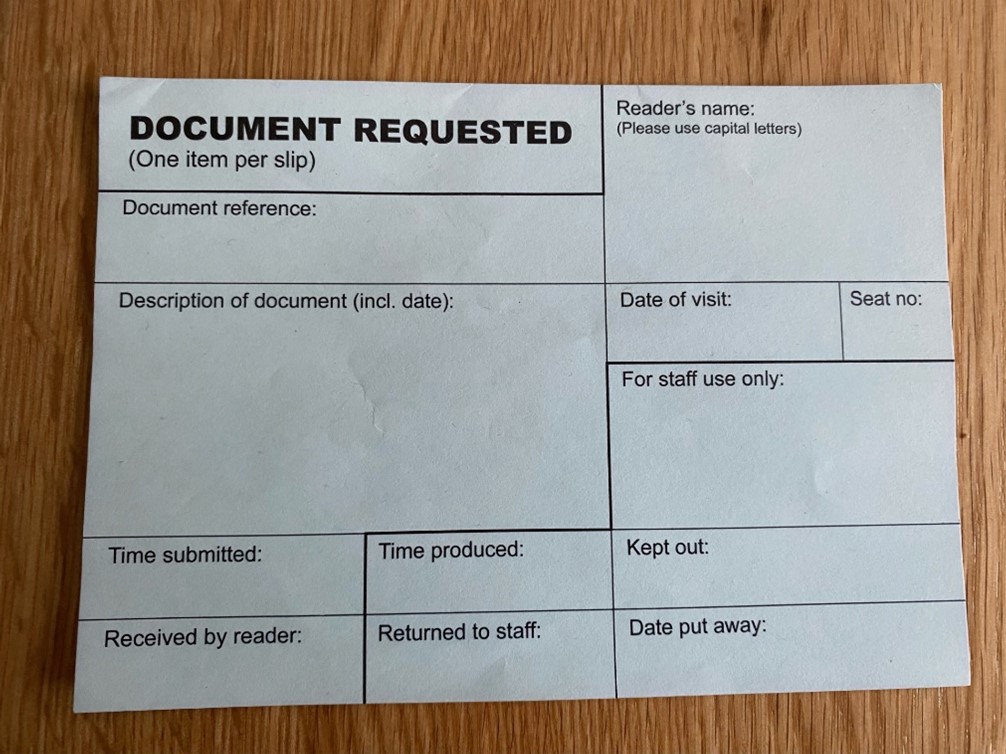
It was also interesting to see how the document production system worked with a three fold slip of pink, blue and yellow helping to identify the document and mark its’ place in the archive whilst it was withdrawn. I was able to help in the returning of Bagnalls documents (negatives of train plans) to their right places, and identifying a specific entry in a marriage register from 1845 that had been requested!
On the Thursday, I worked under the guide of Ben (the team’s Digital Officer), using the online image database Staffordshire Past Track. My task was to find and locate various images based off of listed prompts, noting down their title and reference number – this has helped me develop my competence in using online databases such as this, but was also entertaining to identify areas I recognised well from a century or so earlier; including the road where my house would come stand!
In the afternoon, I worked with Hannah (the team’s Community History Development Officer) in updating the service’s reminiscence programme for people with dementia. This included using Past Track again to locate images of old Staffordshire cinemas, and using a more comprehensive archival search tool Gateway to the Past to find old cinema listings and other such things that would help bring back memories. As well as opening my eyes to just how varied jobs can be within this sector, it has also shown to me just how many people benefit from knowing history such as those with dementia all the way to young children, and just how sensory that experience can be in both cases.
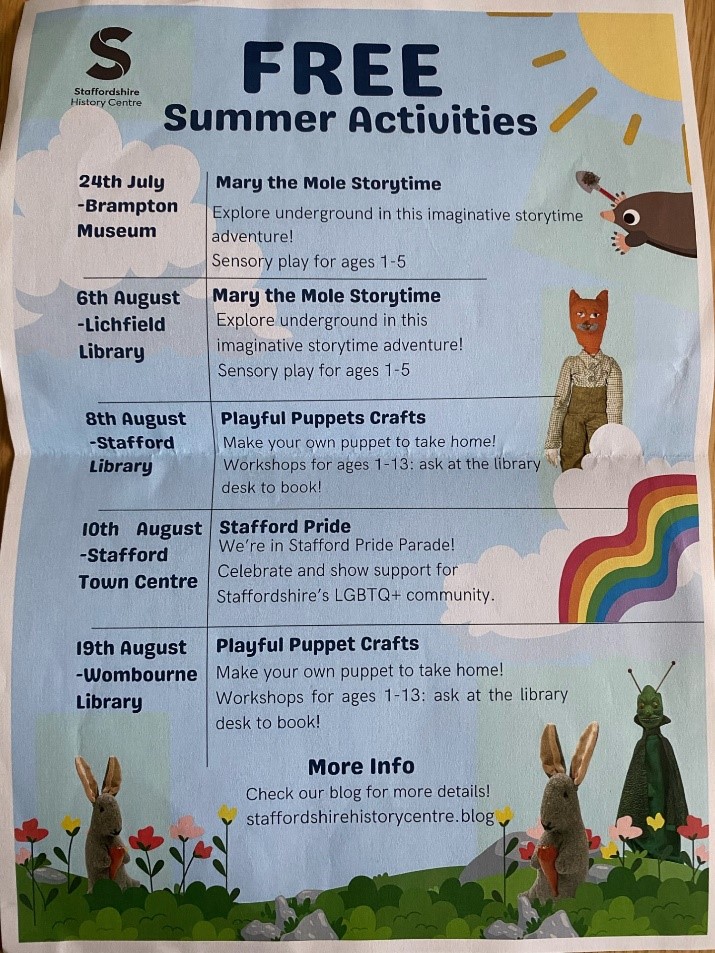
On my final day with the service, I returned to the organisation of the microfiches from Monday but was also fortunate to get to develop my newfound online design skills further by helping Lizzie design promotional posters showcasing the service’s free summer events programme which will be distributed to local libraries to increase publicity.
I also helped the History Centre Assistants set up and prepare for researchers coming in to use the documents I had helped retrieve on Wednesday. I got to learn about the Archive Access Card the service (and most other archives use), and how the team track the variety of reasons people request access to documents. I also got to see how the team negotiate the need to take photographs of documents, and how to deal with copyright that may arise in this situation. Yet again, an instance of what seems simple being more complicated that anticipated. I also learnt how to handle the documents with care and how to set up the correct cushions for them to be placed on for inspection so that they are conserved as best as possible and protected.
Overall, I have really enjoyed my placement with the service and would highly recommend it to anybody else interested in history. The week has opened my eyes to how vast the variety of roles can be – from digitising documents, to preparing them for research, to preparing history to be engaging and public facing. I have particularly enjoyed my chance to be hands on with these documents, but have also found it rewarding that I have been able to contribute to the service’s outreach programme. I look forward to being able to see the service fully functioning in its’ new home of the History Centre soon!
 Staffordshire History Centre
Leave a comment