Some of the members of our Remote Volunteer Group have been taking a look at some of the settlement papers indexed by our Friday Morning volunteers. The group used the settlement papers relating to Church Eaton, Staffordshire (Ref. D3377/52/48) and the following article shows the sort of information that anyone researching their family history can find from these sources.
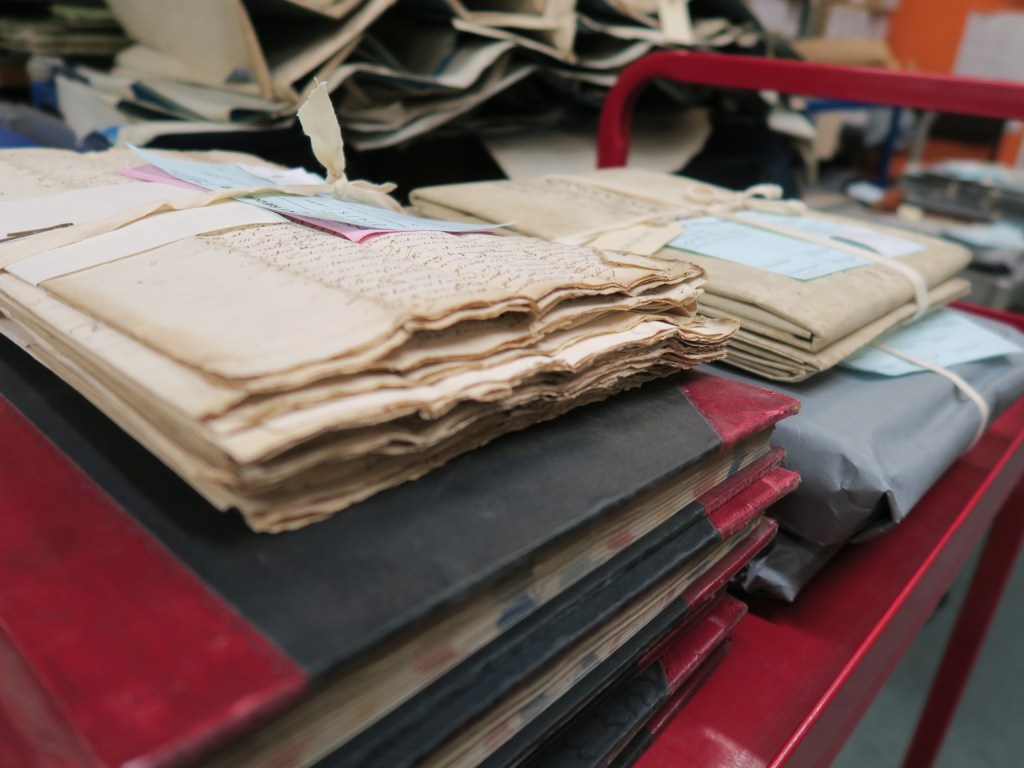
For anyone who suspects that their ancestors lived in Staffordshire, but has failed to find convincing evidence, the settlement examination papers in the Staffordshire Archives collection, could prove to be a boon. The life story of Robert Cox, a brazier of Church Eaton, is a case in point.
Robert Cox was questioned by a single magistrate, the Hon. Edward Monkton JP, on 4th October 1780, to ascertain whether he was entitled to claim parish relief should he fall on hard times. We do not know precisely what questions Monkton asked him, nor how many of Cox’s responses were considered but disregarded and not recorded. The distillation that survives does however suggest a life that was unexpectedly adventurous and eventful.
In response to questions, Robert Cox stated that he was born at Higham Ferrers in Northamptonshire and that his first job, forty five years before the interview, was with Robert Crockett of Church Eaton. He stayed in the job for a full year and received thirty shillings in wages. From this we can deduce he was likely to have been a farm boy about thirteen years old, born around 1722. The parish register of Higham Ferrers shows a Robert Cox marrying a Mary Critchley in that year, perhaps the parents of the examinate. How the youth transferred from Higham Ferrers to Church Eaton, a distance of eighty miles or more, is not explained.
Robert Cox’s next job for a year and a half was back in Northamptonshire, living with Robert Burbage of Staton (Staverton). He was paid two shillings a week when in Staverton but eight shillings and his maintenance when he was on a journey to Chester. Staverton lay at a hub of droving routes, in particular on the Welsh Road. This was a drovers’ route along which the black cattle of Anglesey and North Wales were driven to various cattle markets in England, including Northampton. The cattle would have lost body weight on their long walk and would be fattened up on lush Northamptonshire pastures. The land holding of Robert Burbage (or Burbidge) of Staverton and Byfield can be traced in the Ashby St Ledgers collection in Northampton Record Office. In his later life what thrilling stories Cox could tell of that adventurous time! Perhaps how he had helped the other drovers and their dogs chivy the reluctant cattle to swim or wade over the sand banks across the Menai Strait in a ten minute opportunity between changing tides! Or how he could recognise overnight stopping places by clumps of Scots pine along the route where cattle could safely feed and the drovers be accommodated at inns with names such as the Black Ox, Stocking Farm or Halfpenny House.
Following his time working for Robert Burbage, Robert Cox embarked at the port of Chester and went to sea for 18 months with a Captain Wilkinson. As neither Wilkinson’s first name, nor the name of his ship is recorded, further search is probably fruitless. What is certain is that Robert Cox, a lad from the English midlands, would have acquired many useful nautical skills during his time as a crew member. After his spell at sea, around the year 1740, Robert enlisted with the Royal Dragoons and served for nine years during the War of the Austrian Succession, which included the battles of Dettingen in 1743 and Fontenoy in 1745.
Cox then returned to civilian life in Church Eaton, working again for Robert Crockett. For a full year he was paid five pounds, the equivalent, in present day terms, of less than £600. The Crockett family were both landowners and tenant farmers in Church Eaton and its hamlets for several generations.
Robert Cox may well have decided that he could obtain a better standard of living back in the army. In 1751 he enlisted with the 8th Regiment of Foot and served for twelve years. These middle years of the eighteenth century were a time of almost incessant conflict, both in Europe and the Americas. The 8th Regiment was in Gibraltar in 1751-52 and later in that decade preparing to defend England’s south coast against expected French invasion. When this did not materialise, the 8th Regiment was amongst those troops making sorties onto the French coast.
By 1756 the Seven Years’ War had broken out. Great Britain was allied with Portugal, Prussia and other German states against France in coalition with Spain, Saxony, Sweden and Russia. The 8th Regiment seems to have been in the thick of battle. In 1760 the regiment was fighting in Bremen on the River Weser with many fatalities. The following year saw those troops engaged in several operations and skirmishes around the Electorate of Hanover. In 1762 the campaign concluded with the siege and capture of the town of Kassel. In January 1763, Cox’s regiment started the long march back through Germany and into the Netherlands, where the troops sailed back to England from the small port of Williamstadt. On arrival, the regiment’s numbers were reduced to a peacetime establishment.
Robert Cox left the army after this twelve year service. He did not attempt to gain a settlement anywhere but in Church Eaton, where he was living and working as a brazier at his examination in October 1780. How did he come by his skills as a brazier? Plainly not by apprenticeship when a civilian, but no doubt acquired during his years on garrison duties or when bivouacking on army manoeuvres.
And so ends what the settlement papers reveal about the life and times of Robert Cox. What an adventurous and unexpectedly exciting life he led! In his old age did he tell his tales to the boys of the chantry school in Church Eaton as they crossed the churchyard from their lessons? Perhaps he regaled his cronies around the fireside with tales of far-off places and battles long ago?
Time line
- c. 1722 Born Higham Ferrers, Northants
- c. 1735-36 Worked for Robt. Crockett of Church Eaton
- c. 1736-38 Travelling work for Robt. Burbage of Northants
- c. 1738-39 Abroad with Capt. Wilkinson
- c. 1740-49 Enlisted and served with Royal Dragoons
- c. 1750 Worked again for Robt. Crockett of Church Eaton
- c. 1751-63 Enlisted and served with the 8th Regiment of Foot
- c. 1763- Worked as brazier in Church Eaton
- October 1780 Settlement examination in Church Eaton
Notes and further reading
1. The Cox name could be pursued in the Church of England parish register and other records as they become more plentiful. A John Cox, shoemaker of Church Eaton, made a will proved in Staffordshire Archives in 1800 and the surnames Cox and Critchley can still be found in Church Eaton.
2. The National Army Museum website covers many topics, including soldiers’ diet.
3. Drove Roads. With every decade that passes, the drove routes become more difficult to identify – trees die, road layouts are changed and former inns lose their distinctiveness – localdroveroads.co.uk is recommended. Penelope Lively’s children’s book the ‘The Driftway’ is an evocative account of past time on the unmetalled green lane, Banbury Lane.
 Staffordshire History Centre
Leave a comment