History Access Point volunteer Alex explores the story of one of Lichfield’s famous sons.
One of the things I like about Lichfield is its close and visible relationship with its history. The cathedral, Guildhall, Erasmus Darwin museum, Dr Johnson’s Birthplace – all of these fabulous buildings proudly boast their connections to the past. As such, it can be easy to miss more modest celebrations of centuries gone by. Just opposite the History Access Point is 5 Breadmarket Street, a handsome brick building currently home to Ansons Solicitors. Above the door is a simple plaque that reads:
Priests’ Hall
The Birthplace of
Elias Ashmole
Windsor Herald to Charles II
Founder of the Ashmolean Museum, Oxford
Born in May 1617 to Simon and Anne, Elias Ashmole grew up in Lichfield, attending the local Grammar School and becoming a chorister at the cathedral. Inspired by his hero, the famous Elizabethan polymath John Dee, Elias studied geometry, mathematics, astronomy, and astrology at Oxford University, and even referred to himself as Mercuriophilus Anglicus (the English Mercury-lover). Because of his wife Mary’s wealth, Elias could devote himself to his academic pursuits ‘without being forced to take paines for a livelyhood in the world’. He published widely throughout his life, patronised fellow academics, and even charted a horoscope for King Charles II, who in turn conferred on Elias the honour of the office of Windsor Herald in 1660. 1683 saw the crowning achievement of Elias’ life: the opening of the Ashmolean at Oxford, Britain’s first public museum which continues to delight visitors to this day.
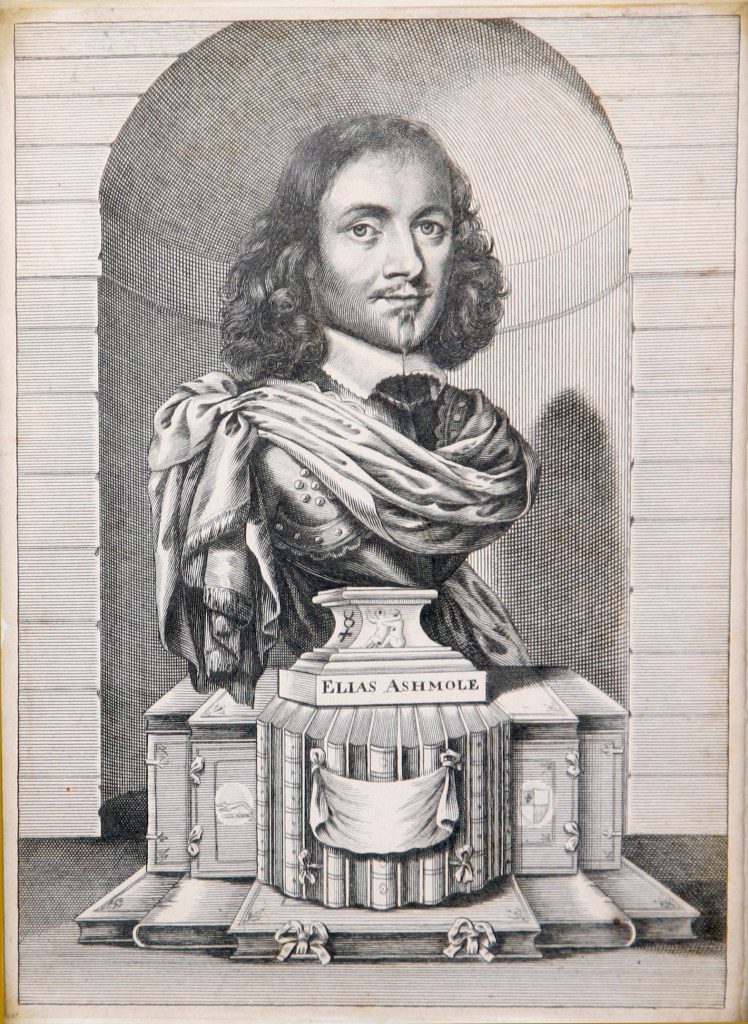
Despite his successes elsewhere, Elias retained close ties to Lichfield throughout his life. Tobias Churton’s biography of Ashmole tells a story about the 1646 siege during the Civil War. Elias was home following his mother’s death when he witnessed Parliamentarian forces burning cathedral records – precious, one of a kind materials that would have been lost forever if Elias had not intervened and saved what he could from the fire. In 1660, upon meeting the newly restored Charles, Elias discussed the poor state of the cathedral and advocated for it to be rebuilt. He later moved into politics and sought election to parliament in 1678 representing Lichfield, although he did not win. He tried again seven years later but this time withdrew his candidacy after learning that James II had (very democratically) promised the seat to a friend.
Although not the most famous son of Lichfield, Ashmole’s contribution to preserving the city’s history cannot be understated. You can read all about Elias Ashmole, and many other renowned Lichfieldians, at the History Access Point. Located on the first floor of the Hub at St Mary’s, the HAP has a wide range of reference books about the history of Lichfield, its residents, architecture, and the surrounding villages. We also have free online access to FindMyPast, Ancestry, local parish records, and electoral registers, as well as handy guides on how to research your family tree. We are open Tuesday-Saturday, with our team of volunteers on hand to answer any queries you may have on Tuesday and Thursday mornings. For more information and our opening times, click here.
 Staffordshire History Centre
Leave a comment