The museum collection has recently been given four samplers made by members of the same Staffordshire farming family. The textiles date from the mid-19th century. The joy of samplers is that they usually contain the name of the person who made it, along with the date. On one of these examples, we also have the address, Elmhurst Farm, Whitgreave.
Three of the samplers were made by different generations of the family when they were young girls; Elizabeth Cottrell, her daughter Mary Hannah Shaw (below left) and her daughter Ethel Dorothy Myatt who made the sampler celebrating King Edward VII in 1905.
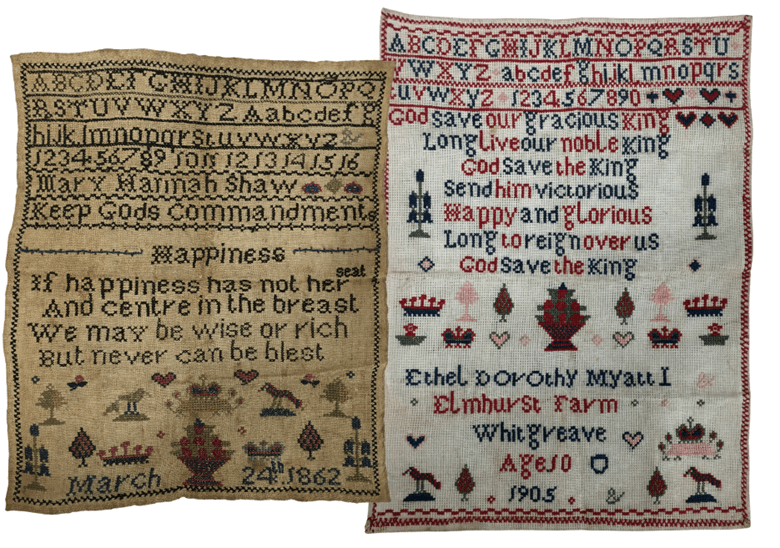
Mary Hannah Shaw, 1862 (left) and Ethel Dorothy Myatt, 1905 (right)
The word sampler is derived from the Latin work ‘exemplum’ meaning an example. They are mentioned in wills and inventories from the 16th century onwards.
Early samplers were often strips of fabric, usually linen, with examples of patterns that an individual had seen or had copied from other people. They acted as reference tools, recording patterns which were then passed down through families. By the 19th century samplers had moved away from being a way to record a pattern and had become a method of teaching children different sewing techniques, helping girls to develop the needlework skills they needed in the home, or at work, as adults.
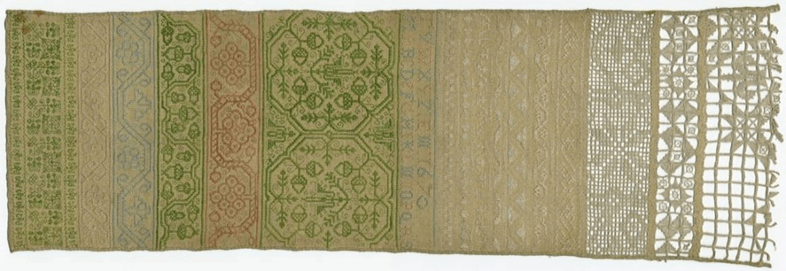
Band sampler completed by E.M, 1670 (79.010.0106)
During the 17th century samplers were often long and thin and had designs worked on them in bands such as acorns and mermaids. Many, like this one, have areas of cutwork where buttonhole stitch was applied over a piece of net. This could then be cut away to leave the design. Cutwork was frequently used on cuffs and collars.
By the 18th century samplers were rectangular. They often had a border and contained many different motifs and designs; trees, houses, and birds were common. Coronets were often included as many girls went into domestic service where they needed to use their needlework skills to mark the linen of the household. If they worked for an aristocratic family, they would have had to sew the relevant coronet onto each item of underwear so that they could be identified.
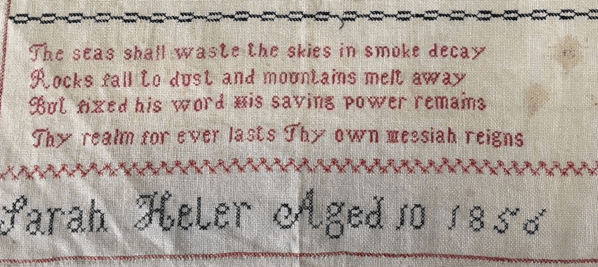
Sampler with religious text by Sarah Heler, Aged 10, 1856 (76.039.0009)
Many samplers included a religious or moral verse such as part of a hymn or a few lines from a psalm. Sometimes the entire Creed, Lord’s Prayer or the Ten Commandments was included. This ensured that the child learnt them off by heart. Samplers had an important educational role to play. They were a record of an individual’s skill and the ability to sew became an important part of a young girls’ education. For a young lady, it was a necessary accomplishment, but for working class children it could be the means to obtaining employment.
During the 19th century the use of the alphabet, numbers and text was important in showing the proficiency of the individual in using different styles of lettering. The letters were often surrounded by a decorative border. Honeysuckle was particularly popular.

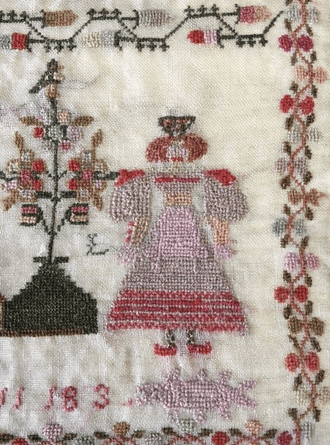
Details from a sampler by Mary Jones, aged 11, 1830s (80.025.0001)
Some early 19th century samplers are very elaborate. This shows two girls dressed in the fashions of the 1830s, complete with a large open bonnet and fashionable top-knot hairstyle.

Map of England and Wales, by Mary Jane Moore 1870 (66.051.0001)
Samplers were sometimes used to teach geography. Map samplers can show whole countries, as in this example which shows all the counties of England and Wales, or details of a small district or county. The maps are not always very accurate and place names were often put where they would fit best, rather than where they ought to have been!
“The Workwoman’s Guide”, published in 1840, includes a printed sampler of the different styles of lettering, and lists when they should be used. For example, Italian characters were used for marking pocket handkerchiefs and other fine articles of dress.
As the 19th century progressed samplers became more and more similar in design. Pattern books were produced, and the sampler became a common exercise carried out by schoolgirls across the country.
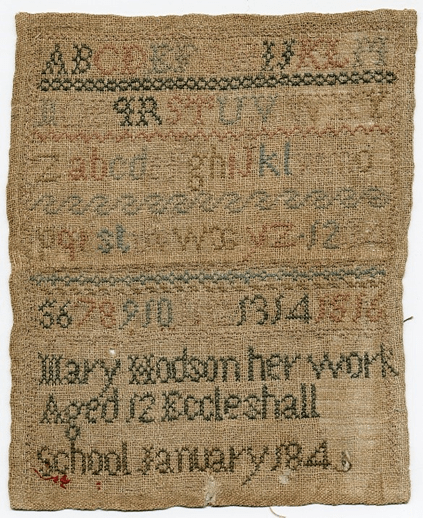
Sampler by Mary Hodson, aged 12, Eccleshall (80.110.0001)
From the museum’s point of view it is really useful that samplers often include the name of the person who worked them, the date and sometimes the place. The collection holds a number of samplers which come from local villages including Eccleshall, Fulford and Great Hayward. This means we can link the samplers with other objects in the collection.

Example of plain sewing by Maria Bescoby stitched on to paper (70.013.0004)
In addition to decorative samplers the collection has examples of plain sewing. The sewing machine was invented in 1857 but it was a very expensive commodity which many households could not afford. It was felt that it was necessary for girls to learn hand sewing techniques and to maintain a knowledge of different stitches and processes such as tacking, gathering and inserting darts and gussets. These examples of different techniques became more common in the later 19th and early 20th centuries. In the late 19th century City and Guilds examinations were introduced and these examples of different sorts of needlework became very important in attaining a qualification.
Helen Johnson – Community Engagement & Partnerships Officer
 Staffordshire History Centre
Leave a comment