An important document which was featured in a recent shipwreck exhibition “Last Voyage of The Gloucester” at Norwich Castle Museum & Art Gallery, and has now safely returned to Staffordshire.
The Gloucester sank in the North Sea off the coast of Norfolk in 1682 while carrying the future King of England and Scotland, James Stuart. After lying on the seabed for 325 years, the ship was discovered in 2007. Due to the age and prestige of the ship, the condition of the wreck and the accident’s political context, the discovery has been described as the most important British maritime discovery since the Mary Rose.
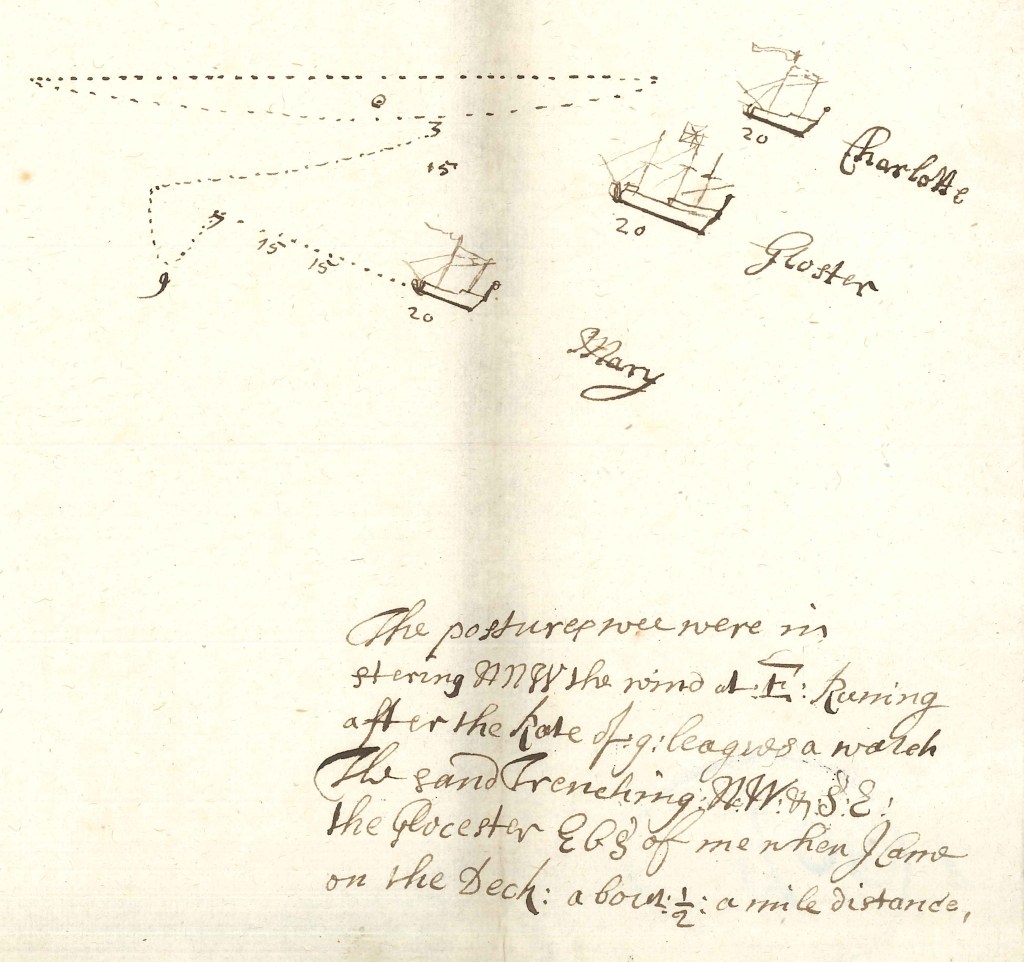
A close up of the document featuring drawings of the ships D(W)1778/I/i/708.
The document is a contemporary copy of a narrative by Captain Gunman, written as an appeal after Gunman’s court martial in June 1682. He was captain of sister ship the Mary and was accused of failing to give sufficient warning. The narrative contains a very detailed account of the incident and what happened afterwards, with reference to the behaviour of other seamen, witness tampering, activities of creditors and “phanaticks”. The document has two sides of densely-written text and a sketch plan showing the positions and courses of three ships, the Charlotte, the Gloster [sic] and the Mary, and a note about the wind direction and the sand on which the ship ran aground.
You can find out more about the The Gloucester and the shipwreck on the project website.
The document is from the collection of the Earls of Dartmouth. George Legge was created 1st Baron Dartmouth in 1682 after a distinguished naval and military career, as Governor of Portsmouth, Master of the Horse to James, Duke of York, and Lieutenant General of the Ordnance, then appointed Admiral of the Fleet. The Legge family estate was in Sandwell, later moving to Patshull. The family’s significant archive collection is held at Staffordshire Record Office. The document reference number is D(W)1778/I/i/708.
Liz Street – Collections Officer
 Staffordshire History Centre
Leave a comment